
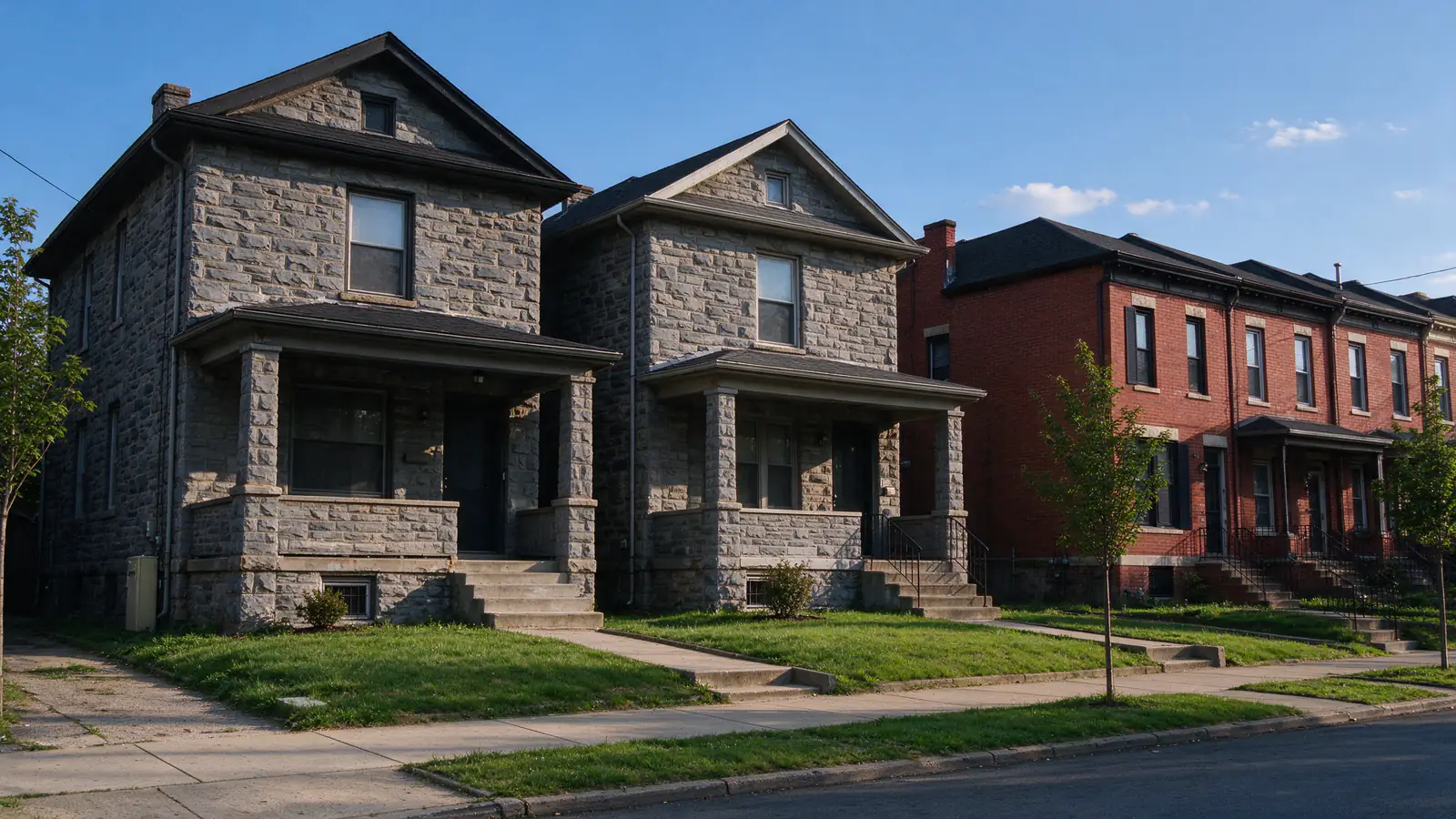
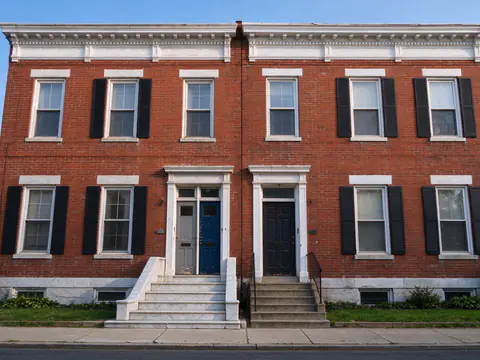
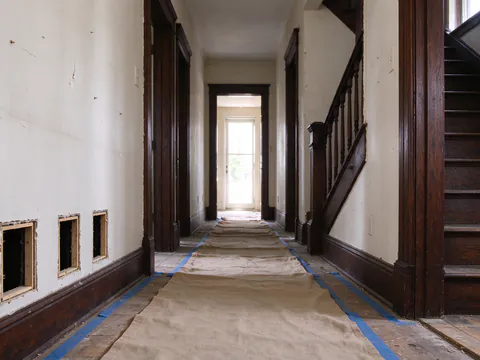
Along Germantown Avenue the oldest houses were built from the ground they stand on: Wissahickon schist, laid as rubble and sometimes coated in stucco. A wall like that has no hollow cavity for a fish tape, and that one fact shapes a large share of the planning for any knob and tube replacement in Germantown. Philly Knob & Tube plans and manages knob and tube replacement for Germantown houses, from the stone houses near Cliveden and Wyck to the brick rows of Penn-Knox, Wister and Morton, and licensed, insured electrical contractors carry out the wiring. Stone, brick, the age of each wing and the type of historic listing all decide how cable reaches each room.
The National Register nomination for the Colonial Germantown Historic District describes the early houses as built “almost exclusively of Wissahickon schist rubblework.” The district runs about twenty-one blocks along the avenue and takes in nearly 500 buildings, so stone construction is not a curiosity here. It is also not the whole story. Slightly more than 10 percent of them predate 1800, while more than 70 percent were designed after the Civil War, and the side streets are lined with rowhouses and twins built over the following century. A Germantown job therefore starts by asking which kind of building this is, and in many houses the answer is several kinds joined together.
Schist walls and the routes they rule out
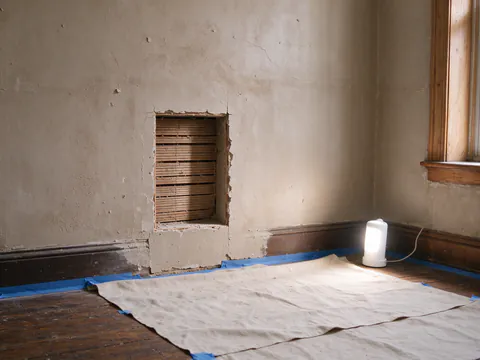
In a frame house or a brick row with furred plaster, an electrician can often drop a new cable from the attic or push one up from the basement inside an outside wall, cutting only small openings at the boxes. A rubble schist wall does not allow that. The stones are irregular, the mortar joints are packed, and the plaster is either applied directly to the masonry or carried on wood furring strips with only a shallow gap behind it. There is no continuous channel to fish through.
That changes the routing plan in predictable ways. Outlets that sit on an exterior wall are usually fed from below, with the cable rising through the floor at the baseboard rather than dropping down inside the wall. Switches and fixtures are moved toward interior partitions, which in an old stone house may be wood stud or lath walls that do have cavities. Closets, stair walls and the space beside a chimney breast become vertical paths between floors. Where none of those reach a location the owner wants to keep, a painted surface raceway along the baseboard or ceiling line is the honest alternative to cutting a channel into the stone.
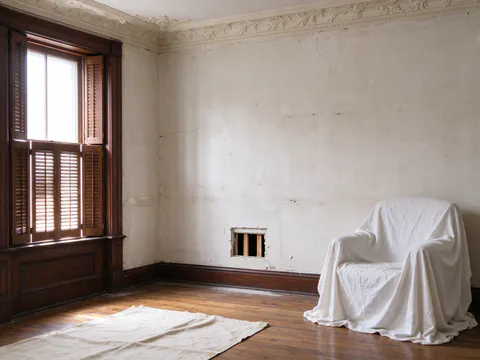
Surface raceway is often treated as a last resort, but in a stone house it has real advantages. It leaves the masonry untouched, it can be painted to match the trim, and it can be removed later without damage, which matters to owners who care about the original fabric. The trade-off is appearance and the space it takes along a baseboard. Cutting into plaster on stone, by contrast, means patching a surface that was applied in thick coats directly to an uneven backing, and that repair is slower and more visible than a patch on lath. Which of the two costs less depends on how many locations are involved and how much finished plaster the owner wants to keep.
None of this is decided from the street. Some Germantown stone houses were re-plastered on new furring during a twentieth-century renovation, which can open up routes the original wall never had. Others have deep window reveals or later wood paneling that change the options again. The knob and tube inspection is where those details get recorded room by room, and the guide to replacing knob and tube without gutting walls explains how openings are placed when cable has to go somewhere the wall won’t let it.
Brick rows and twins in the same neighborhood
The City Planning Commission’s Upper Northwest district plan, prepared in 2017, counted single-family rowhouses as about 43 percent of residential parcels in the planning district, with twins at 32 percent and detached houses at 15 percent. It placed most of those rowhouses in the eastern end of the district: Germantown, East Germantown, Blue Bell Hill and East Mount Airy.
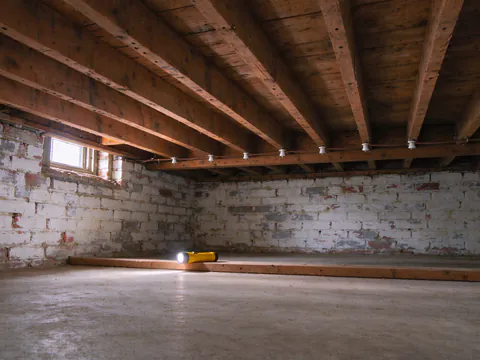
A rowhouse rewire works on different terms from a stone house. Two of its four walls are party walls shared with neighbors, so cable stays off them. The front and rear walls are often brick, which raises some of the same limits as stone, though a furred plaster finish on brick is more common than on rubble. The useful paths in a row tend to run front to back: through the basement ceiling where it is open, up an interior partition or a stair wall, and across the attic or the joist space under the top floor. A twin adds a third exterior wall and sometimes more freedom on that side.
The practical result is that two houses a few blocks apart in Germantown can need very different amounts of surface work for the same number of circuits. That difference belongs in the written scope, not in an assumption made from a listing photo. Owners of a row with deep plaster on every wall will find the plaster wall rewiring page useful for how openings are sized and patched.
Wiring from more than one century in one house
Germantown buildings were rarely finished once. A stone front block from the 1700s may carry a Victorian rear wing, a kitchen added after the Second World War and an enclosed porch from later still. Each phase was wired, or rewired, with whatever method was current, so a single house can hold open knob and tube conductors in one part, armored cable in another and modern cable in a third, all meeting at junctions somebody made decades ago.
Mixed systems are where most planning mistakes start. An outlet that looks new can be fed from an old run upstream. A room that was “redone” may have had new devices installed on the original conductors. Abandoned porcelain knobs in an attic can sit beside a live branch that still serves the front bedrooms. Telling active from abandoned wiring takes testing and tracing, not a glance; the guide to mixed knob and tube and modern wiring walks through how those layers are sorted, and the splices and junction boxes guide covers the connection points where old and new conductors meet.
For a Germantown owner the decision is usually whether to replace only the circuits that are still knob and tube or to replace everything from one era onward, because a house assembled over two centuries rarely has a clean dividing line. The partial versus full replacement guide sets out how that choice is made once the map exists. If the circuit count and wall types point toward replacing everything, the whole-home rewiring service describes how that larger job is sequenced.
Apartments over the storefronts
The Colonial Germantown nomination notes that many residents of the avenue’s commercial row buildings “lived in the apartments above the stores.” That pattern carries into the housing data. In ZIP code 19144, which covers most of Germantown, the U.S. Census Bureau’s American Community Survey counts 19.0 percent of housing units in buildings with two to four units, against 14.4 percent citywide.
Small multi-unit buildings raise questions a single-family house does not. The shop and each apartment may run on separate meters but share old branch wiring that was extended between floors over the years. Shutting off one unit’s circuits for work can cut power to the people living upstairs. The permit path also changes: L&I’s simpler EZ route covers alterations to one-and-two-family dwellings, and buildings with more units follow a different review. When the job involves occupied units, phasing and the separation of each unit’s circuits, the multi-unit knob and tube replacement page covers how those projects are organized.
National Register districts and the Philadelphia Register
Germantown has several historic designations layered over one another, and they do not all do the same thing. Two National Register districts cover large areas: Colonial Germantown along the avenue, and Tulpehocken Station, listed in 1985 and roughly bounded by McCallum Street, West Walnut Lane, the rail line and West Tulpehocken Street, with Late Victorian and revival-style houses from 1850 to 1949.
National Register listing is a federal recognition. On its own it brings no review by the City of Philadelphia, so an owner in either of those districts is not seeking Historical Commission approval simply because the house is listed. City review comes from the Philadelphia Register. The Historical Commission’s list includes several local districts in or near Germantown: Germantown Urban Village, designated in 2024; Manheim Square, a row of five brick and stone houses built between 1834 and 1843 on Manheim Street; and Awbury and East Logan Street, both designated in 2010. Individually designated buildings are on the register too.
Where a house is on the Philadelphia Register, the Historical Commission reviews exterior changes, and its published list of reviewed work includes wiring and conduit on exterior facades and roofs. Interior rewiring falls outside its jurisdiction unless the interior itself is designated. For a knob and tube job, that usually narrows the question to the outside of the building: a meter moved to a new spot, a conduit run on a side wall, or a service mast. Those items should be settled before the interior plan depends on them. The historic home knob and tube replacement service and the broader guide to knob and tube in historic Philadelphia homes cover how preservation review and electrical work fit together.
What the permit records and Census figures can and cannot say
City of Philadelphia electrical permits that mention knob and tube in their scope, 2007 to the present, give a rough sense of how often this work is documented. Within Germantown’s neighborhood areas, including Wister, 46 such permits appear, about 11.3 for every 1,000 electrical permits, against 5.8 per 1,000 across the city. Since 2021 the local count is 24, or 17.9 per 1,000, while the citywide rate is 8.9.
Those numbers undercount. Many rewiring permits describe the work as a rewire, a new circuit or a panel change without naming knob and tube at all, so the real volume of replacement is higher than any keyword count can show. They also say nothing about a specific address. The same caution applies to housing age: in ZIP code 19144, the American Community Survey counts 12,573 of 24,162 housing units as built in 1939 or earlier, about 52.0 percent, compared with 39.9 percent across Philadelphia. Germantown north of Chew Avenue falls in ZIP code 19138, where the share is 42.9 percent, though that ZIP reaches well beyond Germantown.
An older housing stock raises the odds that original wiring survives somewhere, and nothing more. A house built in 1890 may have been fully rewired in the 1970s, and one built later may still have live knob and tube in a back bedroom. Only a circuit-by-circuit check settles it.
How a Germantown job gets from walkthrough to final inspection
The walkthrough comes first, and in Germantown it covers more than counting outlets. The electrical side identifies which circuits are still knob and tube, which are abandoned and where older and newer wiring join. The building side records which exterior walls are stone or brick, where interior partitions and closets offer vertical paths, whether the basement ceiling is open, and how the attic is reached. Those two sets of notes together produce a routing plan, and the routing plan drives the number and location of openings.
A licensed electrical contractor then applies to L&I for the electrical permit through eCLIPSE. In Philadelphia the owner or the owner’s agent hires a licensed third-party electrical inspection agency, which inspects the rough wiring before walls and floors are closed and the finished work at the end. If the plan involves exterior changes on a property in a local district, that review is lined up alongside the permit. Owners weighing the cost of all this can work through the knob and tube replacement cost guide for Philadelphia or try the cost estimator for a planning figure.
Germantown sits between Mount Airy to the northwest and East Falls, whose 1920s Tudor rows bring a different set. To set up a walkthrough of a Germantown house, use the contact page, or read how the company works first.