
Printable checklist
Knob-and-Tube Quote Comparison Checklist
For Philadelphia owners holding two or three rewiring quotes that are hard to line up. It lists what each quote should state, from circuit count and abandoned runs to who files the L&I permit, who hires the inspection agency and who patches the plaster. Two pages, made to print.
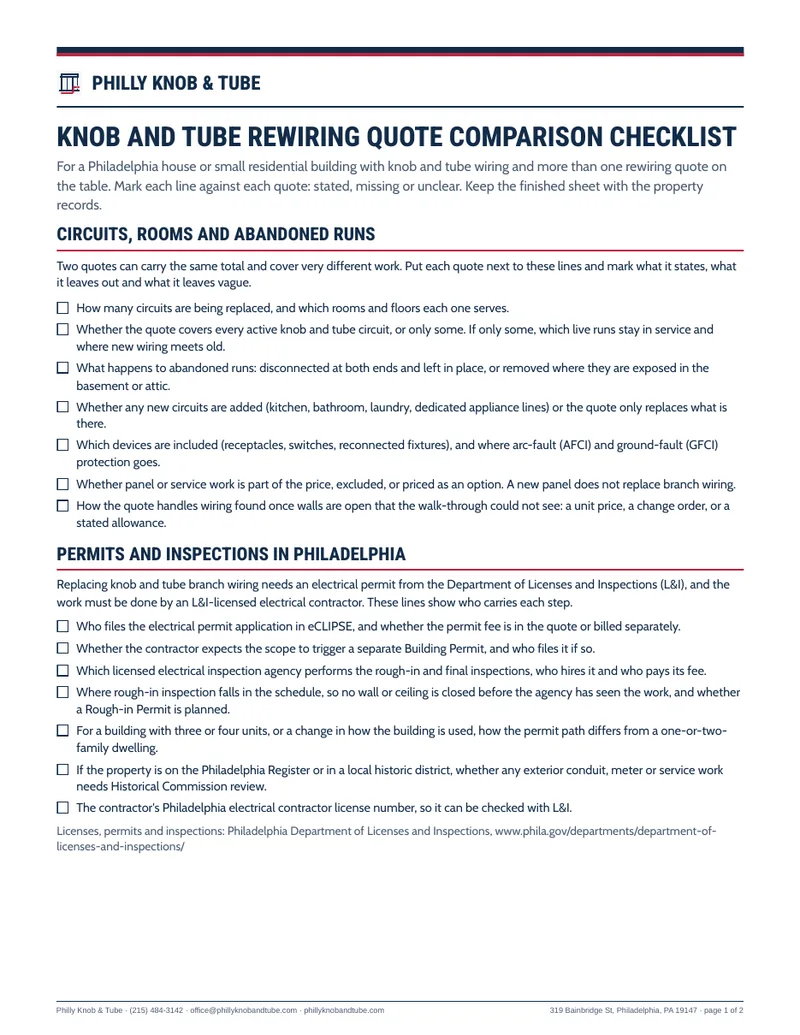
Quote comparison checklist
The same lines as the printable, so you can read them here first. The last section is a sheet to fill in before you request bids.
Circuits, rooms and abandoned runs
Two quotes can carry the same total and cover very different work. Put each quote next to these lines and mark what it states, what it leaves out and what it leaves vague.
- How many circuits are being replaced, and which rooms and floors each one serves.
- Whether the quote covers every active knob and tube circuit, or only some. If only some, which live runs stay in service and where new wiring meets old.
- What happens to abandoned runs: disconnected at both ends and left in place, or removed where they are exposed in the basement or attic.
- Whether any new circuits are added (kitchen, bathroom, laundry, dedicated appliance lines) or the quote only replaces what is there.
- Which devices are included (receptacles, switches, reconnected fixtures), and where arc-fault (AFCI) and ground-fault (GFCI) protection goes.
- Whether panel or service work is part of the price, excluded, or priced as an option. A new panel does not replace branch wiring.
- How the quote handles wiring found once walls are open that the walk-through could not see: a unit price, a change order, or a stated allowance.
Permits and inspections in Philadelphia
Replacing knob and tube branch wiring needs an electrical permit from the Department of Licenses and Inspections (L&I), and the work must be done by an L&I-licensed electrical contractor. These lines show who carries each step.
- Who files the electrical permit application in eCLIPSE, and whether the permit fee is in the quote or billed separately.
- Whether the contractor expects the scope to trigger a separate Building Permit, and who files it if so.
- Which licensed electrical inspection agency performs the rough-in and final inspections, who hires it and who pays its fee.
- Where rough-in inspection falls in the schedule, so no wall or ceiling is closed before the agency has seen the work, and whether a Rough-in Permit is planned.
- For a building with three or four units, or a change in how the building is used, how the permit path differs from a one-or-two-family dwelling.
- If the property is on the Philadelphia Register or in a local historic district, whether any exterior conduit, meter or service work needs Historical Commission review.
- The contractor's Philadelphia electrical contractor license number, so it can be checked with L&I.
Plaster, finishes and living in the house
In plaster-and-lath walls, the openings and what happens to them afterward often explain more of the difference between quotes than the wire does.
- Roughly how many openings, in which rooms, and whether the plan uses basement and attic routes to reduce them.
- Who patches the openings, to what finish level, and whether patching is in the electrical price or a separate trade.
- Whether painting is included, excluded or left to the owner.
- How floors, furniture and original trim are protected, and how dust is controlled in rooms being worked on.
- For an occupied home or a building with residents in other units: which circuits are off each day and how long power interruptions run.
- The schedule the quote assumes: working days, the order of floors or units, and what has to be clear before work starts.
Records delivered at closeout
These are the papers an insurer, a lender or the next buyer asks for. A quote that names them is easier to hold to.
- The electrical permit number and the passed final inspection report from the inspection agency.
- A circuit list showing which circuits were replaced, which knob and tube runs were found live, and which were left in the walls disconnected.
- An updated, labeled panel directory.
- Photos of open walls and ceilings before they were closed, if the contractor takes them.
- A written statement of any knob and tube left in service and where it is, for partial jobs.
What to record before you request bids
Give every contractor the same starting facts, so the quotes answer the same question. Fill this in before the first walk-through.
- Property address
- Building type: single-family, twin or rowhouse, or number of units
- Year built, if known; panel or fuse box location and type
- What a home inspector or insurer wrote about the wiring
- Rooms where knob and tube has been seen
- Basement ceiling: open or finished; attic or roof space access
- Plaster walls, ceilings or trim you want protected
- Historic designation (check for the address)
- Deadline: settlement, policy renewal or renovation start
Download the checklist
Send the short form and the download link appears right under it. If you would also like a walk-through of a Philadelphia property, say so in the message.
Call (215) 484-3142Philly Knob & Tube319 Bainbridge St, Philadelphia, PA 19147
office@phillyknobandtube.com