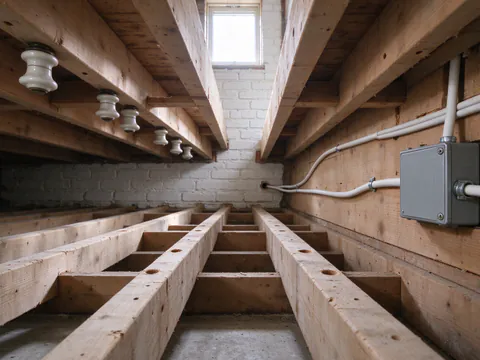
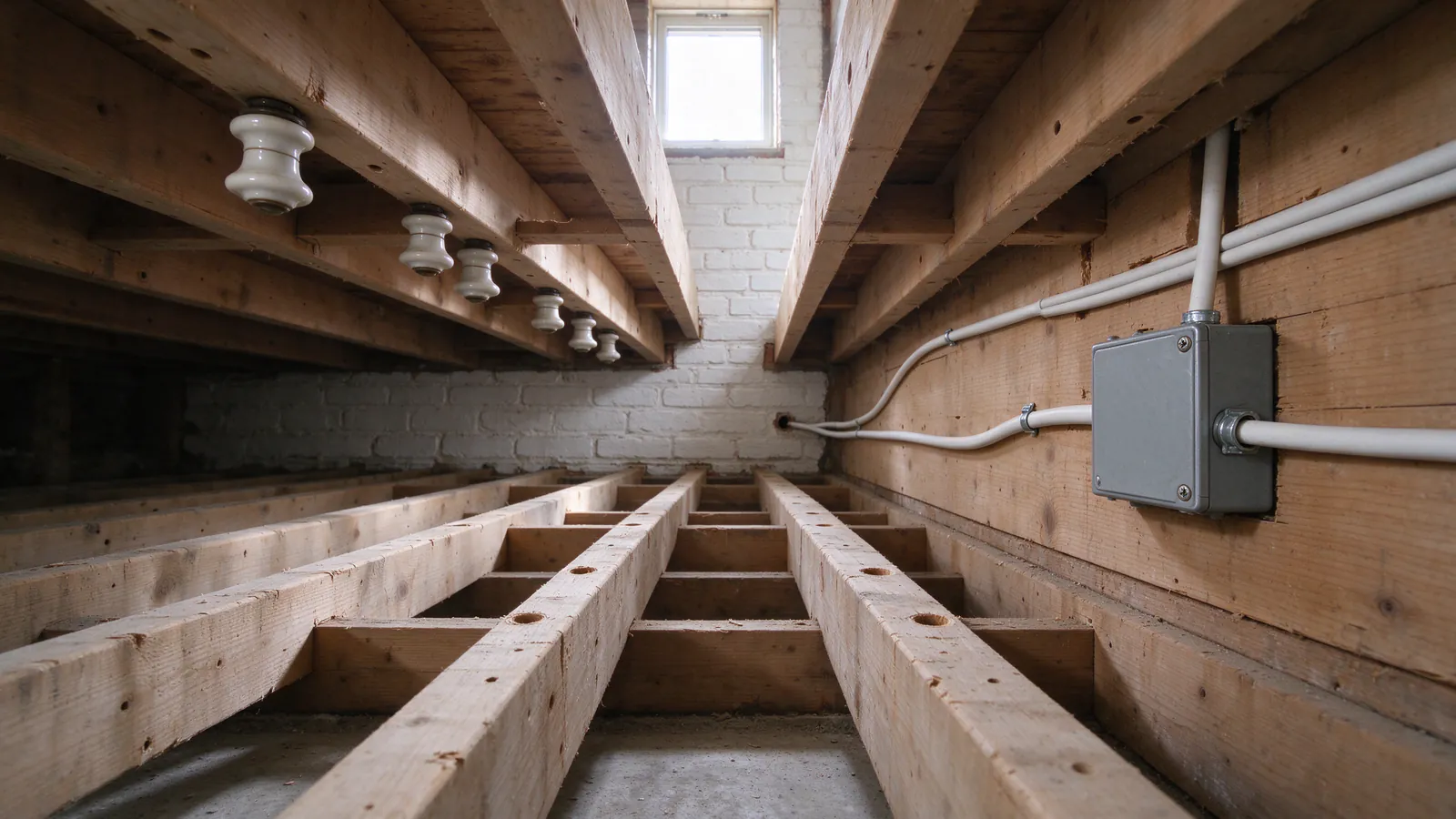
Yes, knob-and-tube and modern wiring are often mixed on the same circuit, and in many old houses they already are. A remodel, a new panel or a single added outlet can leave modern cable fed by original conductors upstream. Some transitions can be made properly by a licensed electrician; many existing ones were not, and none can be judged by sight. Philly Knob & Tube organizes partial and full knob-and-tube replacement for Philadelphia homes, with licensed electrical contractors doing the tracing and wiring, and mixed circuits are where most of that scope gets decided.
Why Renovated Rooms Can Still Have Active K&T
Mixing rarely happens on purpose. It accumulates, one practical decision at a time, over a century of ownership.
The most common pattern is the nearest-power extension. Someone adds a ceiling fan, a bathroom vent or a basement outlet and picks up power from whatever conductor is closest. In an old house that conductor is often knob-and-tube. The new section is plastic-jacketed cable with a ground wire; the circuit feeding it is still two separate cloth-covered conductors on knobs, and the ground wire in the new cable may connect to nothing at all.
The second is the room-by-room remodel. A kitchen or bathroom gets rewired while open, and the electrician runs new circuits for that room. Walls elsewhere stay closed, so the lighting circuit that passes through the kitchen ceiling to the dining room, or the circuit feeding the second-floor front bedroom, may remain original. In a Philadelphia rowhouse where a rear kitchen was renovated but the main block was not, the first floor can look entirely current while the floors above are not. That is a possibility to check, not an assumption to make about any specific house.
The third is the panel change. Replacing a fuse box with a breaker panel is a frequent upgrade, and it often happens without touching branch circuits. The panel is new; every circuit leaving it may still be knob-and-tube within a few feet. The panel upgrade vs knob-and-tube replacement guide explains why those are separate projects.
The fourth is the device swap. Replacing two-slot outlets with three-slot outlets changes only the face on the wall. Nothing about the wiring behind it changes, which is why the guide to three-prong outlets on ungrounded wiring treats a grounded-looking receptacle as a question rather than an answer.
Finishing a basement adds one more twist. A new drywall ceiling can close over active knob-and-tube runs, turning what used to be visible wiring into concealed wiring, sometimes with new junction points hidden above the finish.
Clues that point to a mixed circuit
None of these proves anything on its own, and none requires touching wiring. Together they tell an electrician where to start looking.
- A home inspection note about an “open ground.” Inspectors plug a tester into three-slot outlets. When it reports no ground on a newer-looking receptacle, the outlet may sit on two-wire wiring somewhere upstream.
- Both wiring types visible near the same spot. Plastic-jacketed cable on a basement joist that disappears into the subfloor a few inches from a line of porcelain knobs, or a metal box in the attic with old cloth conductors entering one side and modern cable leaving the other, marks a likely transition.
- Breakers that serve odd combinations. A single breaker that turns off a new kitchen outlet and an original upstairs light suggests one circuit spanning two eras.
- Mismatched devices on one wall. A new grounded receptacle beside an original push-button switch or a two-slot outlet, all in the same room, hints that only part of the room was redone.
- Permit or invoice history for one room only. Paperwork for a kitchen or bath rewire, with nothing for the rest of the house, outlines where modern wiring is likely to stop.
If you notice any of these, write them down for the electrician rather than investigating further.
What a Legitimate Transition Requires
Some transitions between old and new wiring can be acceptable when a licensed electrician makes them and the conditions support it. The point of explaining those conditions is so you can read an inspection report or a proposal with understanding, not so anyone attempts the work.
An accessible enclosure. Splices belong inside a box that remains accessible without removing part of the building. A transition taped together and buried in a wall cavity or under attic insulation fails that test before anything else is considered. The splices and junction boxes guide covers what boxes do and why later unboxed splices cause trouble.
Old conductors worth connecting to. The rubber insulation on knob-and-tube hardens with age and heat. If the old conductors near the transition are brittle or cracked, connecting to them only extends the life of a weak segment. An electrician assesses the visible condition where it can be reached and treats the unreached sections as unknown.
Protection sized to the weakest wire. A circuit is protected by its breaker or fuse, and that device has to suit the smallest, oldest conductor on the circuit, not the newest. A modern cable rated for more current downstream does not raise the limit of the old wire upstream.
Honest grounding. New cable carries an equipment grounding conductor, but if the circuit upstream has no ground, connecting the new ground wire to nothing does not create one. Any grounding solution has to come from the source.
Current protection rules. Philadelphia enforces the 2020 National Electrical Code. Under that edition, when branch-circuit wiring is modified, replaced or extended in the areas where arc-fault protection is required, the circuit generally needs AFCI protection. Ground-fault protection rules apply in their own locations. Applying either to an old two-wire circuit can be complicated, especially where neutrals are shared, and the AFCI vs GFCI guide explains the practical differences.
A permit and an inspection. Altering branch circuits in Philadelphia is permitted work done by a licensed electrical contractor, with inspections by a licensed third-party electrical inspection agency.
Even when every one of those conditions is met, a transition leaves part of the circuit on original wiring. It is a way to manage a mixed system, not to modernize it.
What Circuit Tracing Can and Cannot Establish
Tracing is how an electrician turns a mixed system from a suspicion into a map. Each circuit is switched off at the panel and the rooms it feeds are recorded. In accessible basements and attics the electrician follows conductors from the panel and notes the points where they change from one wiring method to another. A circuit tracer helps follow runs into walls; existing openings such as fixture boxes and switch boxes sometimes allow a look with a borescope.
Done carefully, tracing can establish:
- which circuits contain any knob-and-tube segment, and roughly where it sits
- where accessible transitions are and whether they are boxed
- whether the protection on each circuit suits its oldest conductor
- whether two circuits share a neutral, which the shared neutrals guide explains
- which old runs are truly disconnected, as covered in the active vs abandoned guide
It cannot establish the condition of insulation inside closed plaster walls, the existence of a splice in a wall cavity nobody can reach, or the absence of every old segment in a floor system that cannot be opened. A good report says which areas were checked and which were not. If a proposal declares a mixed house free of knob-and-tube without saying how the concealed sections were verified, ask.
Some houses also carry a third or fourth wiring method on top of the first two. Armored cable spliced onto knob-and-tube is common, and the knob-and-tube vs BX guide explains how to tell them apart.
How Findings Change Replacement Scope
The map from tracing decides where the replacement line falls. A few patterns recur.
| What tracing finds | What it usually points toward |
|---|---|
| One old home run feeding an otherwise modern room | Replacing that run back to the panel, often a contained job |
| Original circuits confined to one floor or one area | Partial knob-and-tube replacement of those circuits |
| Old segments upstream on most circuits, with transitions scattered through attics and walls | A whole-house rewire may be simpler than chasing each segment |
| Transitions that are unboxed or buried, with brittle old conductors nearby | Replacing the affected circuits rather than reworking the joints |
Partial replacement works best when old and new wiring meet at a small number of known, accessible points, so the finished circuits are entirely modern from panel to device. It becomes less attractive when old segments are spread thinly through every circuit, because each one has to be found and replaced, and the access cuts add up. The partial vs full replacement guide walks through that decision, and the Philadelphia cost guide shows how circuit count and access change the budget.
A mixed house also tends to need more investigation than a fully original one, since an untouched system follows one logic while a remodeled system follows several. That extra uncertainty is a legitimate pricing driver.
Where to Go From Here
If you know or suspect your house has been rewired in pieces, gather any permit records, old invoices and the home inspection report, and note which rooms were renovated and when. Do not open boxes or follow wires yourself. The tracing visit described on the knob-and-tube inspection page is the step that turns those notes into a circuit map. When you are ready, request an estimate and mention the renovation history; it shortens the search for transitions. For background on the original system, see what knob-and-tube wiring is, or browse the full guide library.