In many old Philadelphia houses, a circuit’s neutral does not travel alongside its hot conductor, and one neutral may carry return current for more than one circuit. Knob-and-tube installers routed the two conductors separately by design, and later work often tied neutrals together. That hidden routing complicates testing, AFCI and GFCI upgrades, and partial replacement. Philly Knob & Tube coordinates knob-and-tube replacement in the city through licensed electrical contractors, and mapping neutrals is one of the first things a careful partial scope has to settle.
How Old Circuits Were Routed
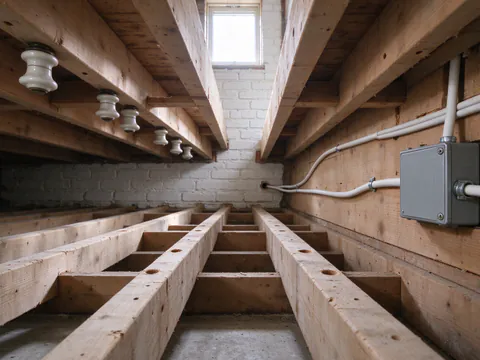
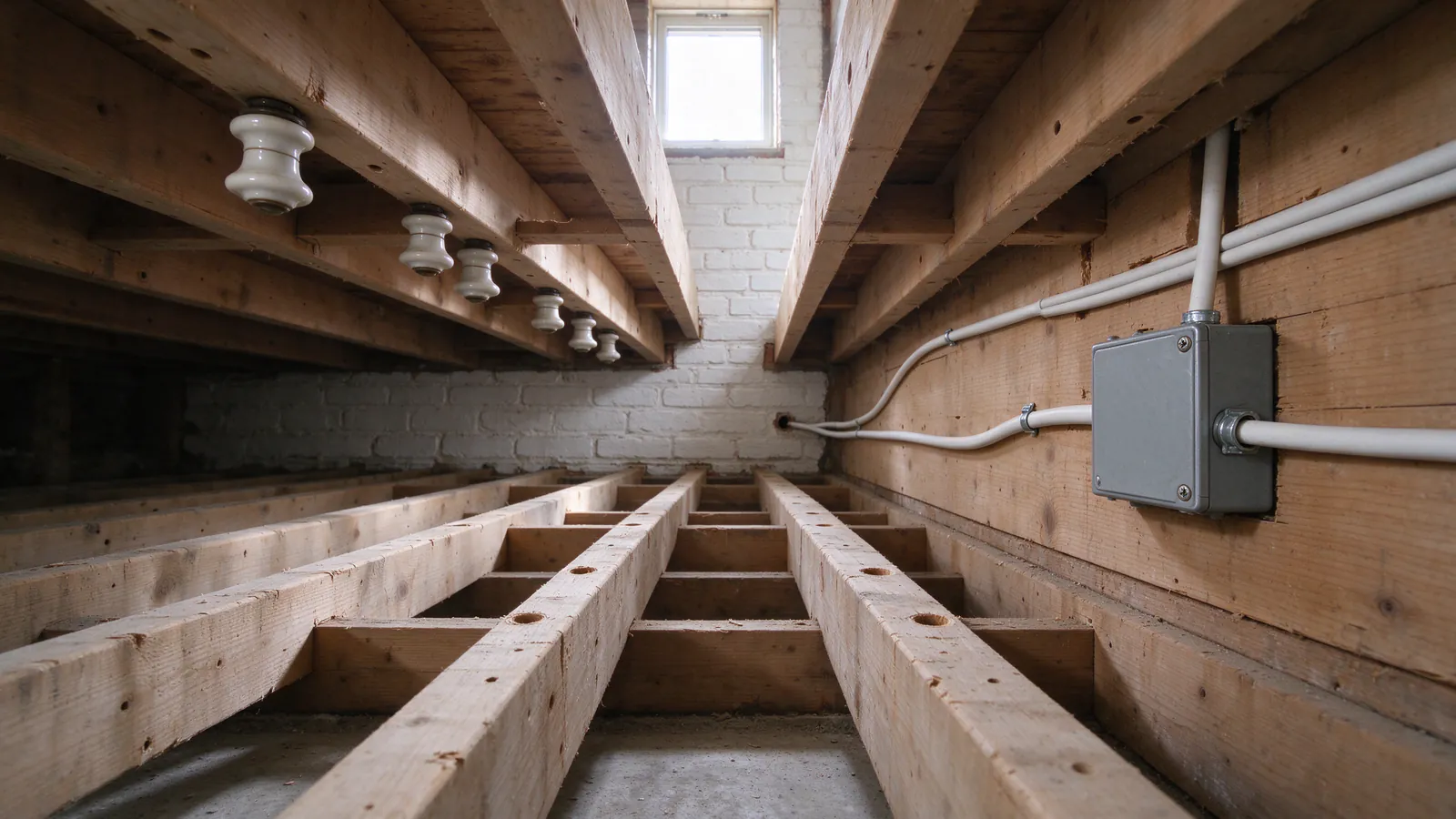
Modern cable binds a circuit’s conductors together, so the current going out and the current coming back always travel side by side. Knob-and-tube did the opposite. Each conductor was a single wire on its own line of knobs, and the installer chose the most convenient route for each one. A hot conductor might run straight down the center of a basement ceiling while its neutral followed a different joist to the same fixture. As the guide to identifying knob-and-tube explains, the separation was intentional, because distance kept the conductors cool and apart.
Separate routing allowed some economies that matter today. Installers sometimes ran a single neutral along the length of a house and tapped several fixtures off it, each fed by its own hot conductor. In a narrow rowhouse with one long basement run, that pattern could serve multiple rooms with one return path. It worked electrically, but it means the circuit you identify at the panel by its hot conductor may not have a neutral of its own.
Two older practices add further complications where they survive:
Switched neutrals. Today, a switch must interrupt the hot conductor so a fixture is fully de-energized when switched off. Some early installations, and some later amateur changes, put the switch in the neutral instead. The light goes out, but the socket remains connected to the hot side. Someone changing a bulb or a fixture can be exposed to voltage they believe is off.
Fused neutrals. Some very early fuse equipment protected both conductors of a circuit. If the neutral fuse opened while the hot fuse held, the circuit would stop working but stay energized. Most of this equipment has long since been replaced, but its wiring pattern may remain.
Over decades, remodeling added a third layer. When someone extended a circuit and could not find its own neutral conveniently, they sometimes connected to whatever neutral was nearby. That creates a borrowed neutral: two unrelated circuits sharing one return path through a splice in a wall or attic. Nothing about it is visible from the outlet.
| Return-path pattern | How it came about | What it means for changes |
|---|---|---|
| Separate route, own neutral | Original practice: hot and neutral on different knob lines, same circuit | Normal for the era; tracing must follow both conductors |
| Common neutral for several fixtures | Original economy: one long neutral tapped by several hot runs | Rewiring one fixture can disturb the return for others |
| Multiwire circuit | Two hots on opposite panel legs sharing one neutral | Acceptable when legs and disconnection are right; risky after panel changes |
| Borrowed neutral | Later extension tied to whatever neutral was nearby | Trips protective devices and hides live current; should be eliminated |
Why the panel does not reveal it
It is tempting to assume the panel tells the story, since each breaker has one hot conductor landing on it. Neutrals, though, land on a shared bar, and in an old system several neutrals may have been joined long before they reach the panel, or a single neutral may serve conductors fed by two different breakers. Counting conductors on the neutral bar says nothing reliable about which circuits share a return. The relationships live in the basement, the attic and the walls, which is why they are traced rather than read off a panel schedule.
Why Shared Neutrals Complicate Changes
A neutral normally carries the same current as its own hot conductor, back to the panel. When neutrals are shared or borrowed, that balance breaks, and several practical problems follow.
Turning off a breaker may not make a run safe. If circuit A borrows circuit B’s neutral, switching off A still leaves current from B flowing through the shared conductor. An electrician who opens that neutral can be exposed to voltage on a circuit the panel shows as off. This is one reason status checks must be done by measurement, as the active vs abandoned guide explains.
Ground-fault devices trip. A GFCI receptacle or breaker watches whether the current leaving on the hot equals the current returning on its neutral. A difference of a few milliamps means current is leaking somewhere, and it trips. When a circuit’s return current goes back on another circuit’s neutral, or a neighbor’s current comes back through it, the device sees a mismatch that is not a ground fault at all, and it trips anyway, often immediately. Combination arc-fault breakers that include ground-fault detection react the same way. Homeowners report adding protective devices to old circuits only to have them trip constantly; a shared neutral is one of the common explanations. The AFCI vs GFCI guide covers what each device needs to work.
Neutrals can overload. In a proper shared-neutral (multiwire) circuit, the two hot conductors sit on opposite legs of the panel, so their return currents partly cancel and the neutral carries only the difference. If a panel replacement or rearrangement puts both hot conductors on the same leg, the neutral carries the sum. That shared conductor, old and with aging insulation, can run hot without either breaker tripping, because breakers protect hot conductors, not neutrals.
Losing a neutral misbehaves loudly. When a shared neutral is opened, by a failed splice or by partial rewiring that cut the wrong conductor, loads that depended on it either stop working or end up in series across two legs. That produces flickering, lights that brighten or dim when something else turns on, and possible damage to electronics.
What a Professional Assessment Needs to Establish
An assessment that ignores neutrals can misdescribe a house. When an electrician maps an old system before replacement, the neutral questions sit alongside the usual circuit mapping:
- Which neutral serves which loads. Each hot conductor’s route is traced from the panel, and so is each neutral’s, independently. In accessible basements and attics the two may be on different framing.
- Which neutrals are shared, and how. A deliberate multiwire circuit with two hots on opposite legs is a different finding from a neutral borrowed through a later splice.
- Panel leg positions. For any shared-neutral circuit, the electrician confirms that the hot conductors are on opposite legs and that they will be disconnected together.
- Switched or fused neutrals. Any fixture switched in the neutral, or any remaining neutral fuse, is identified so it is not carried into new work.
- Load on shared neutrals. Measuring current where the neutral is shared shows whether it is carrying more than its share.
These findings are part of the knob-and-tube inspection work, and they explain why that visit takes longer in a remodeled house than in an untouched one. The inspection checklist lists them with the other items worth asking about.
How This Affects Partial Replacement
Partial replacement means rewiring some circuits and leaving others for now. Shared neutrals change where that line can sensibly fall.
Replace circuits by neutral group, not just by room. If the bedroom circuit you want rewired shares its neutral with the hall light circuit, rewiring only the bedroom either leaves the hall without a return path or leaves the old neutral in service for one circuit while another depends on it. The cleaner plan replaces both together, or gives each a new neutral and removes the shared connection entirely.
Plan for the protection the new circuits will need. New or extended branch circuits under the 2020 National Electrical Code, which Philadelphia enforces, generally require arc-fault protection in many living areas, and ground-fault protection in its own locations. Those devices only behave when each circuit has its own neutral. A partial scope that leaves a borrowed neutral in place will run into nuisance tripping on the new work.
Expect transitions to be fewer and cleaner. The goal of a partial replacement is a circuit that is modern from panel to device, with any remaining old wiring on separate, clearly identified circuits. The mixed wiring guide covers why scattered transitions undermine that, and the splices guide explains how buried joints often hide borrowed neutrals. Where armored cable was spliced onto old circuits, its neutral can be part of the same tangle; the knob-and-tube vs BX guide covers that cable.
Budget for the investigation. Tangled neutrals are a legitimate reason a partial job costs more than a simple circuit count suggests, and sometimes a reason a whole-house rewire is the more sensible scope. The partial vs full replacement guide and the Philadelphia cost guide cover how those decisions add up, and the partial knob-and-tube replacement page describes the service itself.
Next Steps
If you have breakers that trip when a new GFCI or AFCI is added, lights that dim and brighten with other loads, or a planned partial rewire, mention it when you request an estimate, along with any recent panel work. Do not try to locate neutrals yourself. For background on why the original system was laid out this way, see what knob-and-tube wiring is, or browse the full guide library.