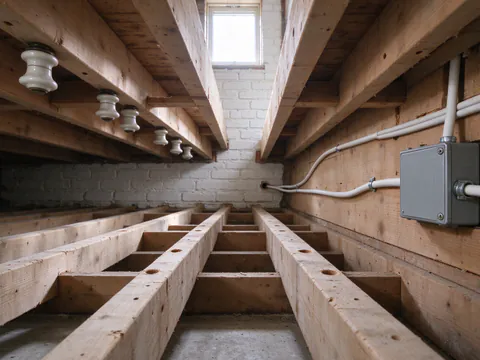
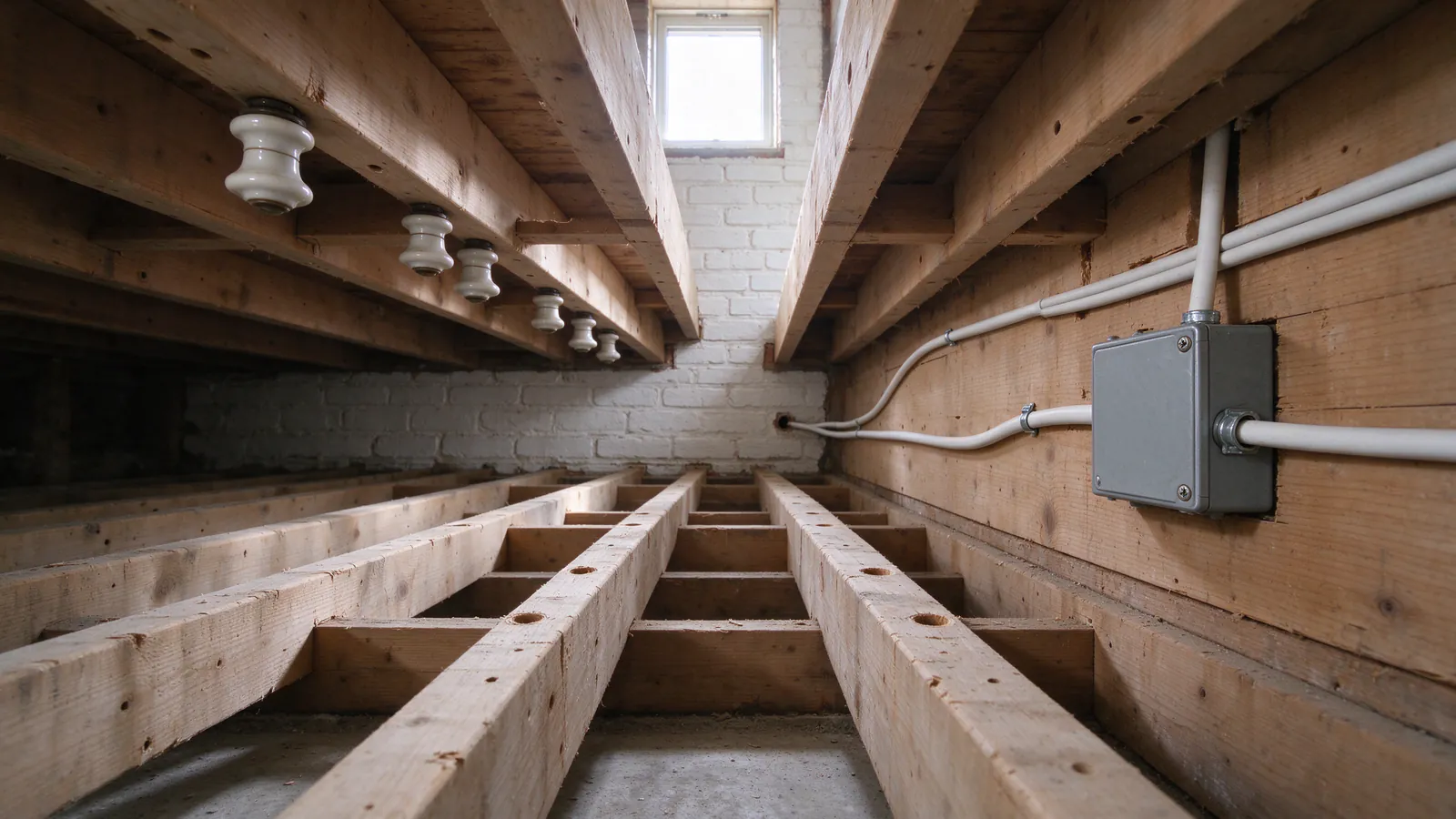
Knob-and-tube wiring can run modern lights and small electronics, but it was not designed for heavy appliance loads. A 1,500-watt space heater draws about 12.5 amps, most of a 15-amp circuit. Add a window AC, microwave or hair dryer to a lighting-era circuit and the old conductors run hot or the fuse blows, and oversized fuses hide that warning.
Philly Knob & Tube plans and manages knob-and-tube replacement for Philadelphia houses and small apartment buildings, and the licensed electrical contractors who do the work design new circuits around how each room is used today. This guide explains why appliance load is often the real reason a replacement scope grows, and how circuit planning fits into partial knob-and-tube replacement or a whole-home rewire.
How the Original Circuits Were Laid Out
When most Philadelphia rowhouses and twins were wired, electricity in a home meant lighting first. A typical circuit might feed ceiling fixtures in three or four rooms and a few receptacles, sometimes on different floors. Rooms had one or two outlets, if any; some had none, and lamps plugged into a socket adapter in the ceiling fixture. Kitchens were not expected to run more than an iron, a toaster and perhaps a refrigerator.
That layout matters today because a circuit is shared by everything on it. A bedroom outlet and the hallway ceiling light two rooms away can be on the same conductors and the same fuse. Plugging a heater into the bedroom loads the wire that runs all the way back to the panel, through every splice along the way. Because original runs were routed for convenience rather than by room, homeowners report being surprised by what goes dark when a single fuse is pulled. Finding that map is one of the first things a knob-and-tube inspection does.
Why Load and Overcurrent Protection Matter
Current through copper makes heat, and heat rises with the square of the current, so doubling the load roughly quadruples the heat in the wire. Knob-and-tube was designed to get rid of that heat by keeping the conductors in open air on porcelain supports. That works within limits. It stops working well when the current stays high for hours, when insulation has been piled on the runs, or when the rubber insulation has already been aged by decades of heat cycles.
The fuse or breaker is the limit. It is chosen to protect the conductor, so it should open before the wire gets hot enough to damage its insulation. Many original branch runs used copper conductors that modern practice protects at 15 amps. An electrician confirms the actual gauge and condition of each run; there is no single amp figure that applies to every old circuit.
The arithmetic for appliances is simple: watts divided by 120 volts gives amps.
| Appliance | Typical rating | Approximate current |
|---|---|---|
| Portable space heater on high | 1,500 W | 12.5 A |
| Hair dryer on high | 1,800 to 1,875 W | 15 A or slightly more |
| Countertop microwave (input power) | 1,200 to 1,500 W | 10 to 12.5 A |
| Toaster oven or air fryer | 1,200 to 1,700 W | 10 to 14 A |
| Window air conditioner, small to mid size | 500 to 1,200 W | 4 to 10 A, more at start-up |
| Vacuum cleaner | 800 to 1,400 W | 7 to 12 A |
These figures come straight from typical nameplate wattages; your appliance’s label gives its own rating. Two observations follow. First, several common appliances can use most of a 15-amp circuit alone. Second, loads that run for three hours or more, such as a heater overnight or an air conditioner through a July afternoon, are treated as continuous, and the national electrical code’s general approach keeps continuous load to 80 percent of the circuit rating. On a 15-amp circuit that is 12 amps, which one space heater already exceeds.
Overfusing: The Problem That Hides the Problem
Original residential fuse boxes commonly use screw-in plug fuses, and a plain screw-in base accepts a 15, 20 or 30 amp fuse interchangeably. When a heater or window unit kept blowing a 15-amp fuse, the easy fix for a past owner was a 20 or 30. The blowing stopped. The wire did not change.
An oversized fuse lets a conductor carry more current than it can safely handle, so the failure point moves from the fuse, where it is harmless and visible, into the wall, the attic or a splice behind plaster. Electricians correct this by fitting the protection to the wire, which on fuse panels can mean tamper-resistant fuse adapters that only accept the right rating. Nobody else should be changing fuse sizes. If a correctly sized fuse then blows under your normal use, that is useful information: the circuit is overloaded and needs to be divided or replaced. The guide to signs old wiring needs attention covers what to do when that happens repeatedly.
What Added Appliances Can Change
Most households did not overload their wiring all at once. It happened one purchase at a time.
- Window air conditioners in upstairs bedrooms of rowhouses are a common case, because the bedroom outlet may share a circuit with the rest of the floor.
- Space heaters used to warm a cold back room run at full draw for hours.
- Kitchen countertop appliances such as microwaves, kettles, toaster ovens and coffee makers often share one or two old circuits that also feed the dining room.
- Home offices add computers, monitors and printers, modest loads individually but continuous during the day.
- Extension cords and power strips move a load from where the outlet is to where the appliance is, but the current still flows through the same old conductor.
Motors add a twist. An air conditioner compressor, a vacuum or a refrigerator draws several times its running current for a fraction of a second as it starts. That surge is why lights on a shared circuit dip when the window unit kicks on. A brief dip is not a fault in itself, but on a circuit with a loose or deteriorated splice, every start-up stresses the weakest connection, and repeated dimming is worth mentioning to the electrician who maps the circuit.
Each addition raises the average load and the time a circuit spends near its limit. Combined with brittle insulation or an altered splice, sustained heavy load is one of the conditions that makes old wiring a concern, as the guide on whether knob-and-tube wiring is dangerous explains.
Dedicated Circuits Versus Existing K&T
A dedicated circuit serves one appliance or one purpose, with its own breaker and its own run from the panel. Current code expects several of them in any rewired dwelling: at least two 20-amp small-appliance circuits for kitchen countertop receptacles, a 20-amp circuit for laundry, and a 20-amp circuit for bathroom receptacles. Appliances such as dishwashers, disposals, built-in microwaves and refrigerators often get their own circuits according to manufacturer instructions and the electrician’s design.
That is why replacing knob-and-tube is rarely a wire-for-wire swap. The new system is laid out by room and by load, with lighting and general receptacles separated from appliance circuits. A bedroom where a window unit runs every summer can get a receptacle on a circuit planned for it. The guide to what replaces knob-and-tube wiring describes the cable, circuit sizes and protection that new circuits use.
In a phased project, load is a sensible way to choose which circuits go first. A kitchen still running on original wiring, or a bedroom circuit feeding an air conditioner, carries more risk than a closet light. The partial vs full replacement guide weighs the trade-offs of doing the heaviest-loaded circuits first and the rest later.
What Determines the Appropriate Scope
Several findings decide how far a project needs to go.
- How many circuits are still active knob-and-tube, and which rooms and appliances each one serves.
- How those circuits are protected, including whether any are overfused.
- What the household runs now and plans to run, such as window units, a new kitchen, a home office or a future appliance that needs its own circuit.
- Panel spaces and condition. New circuits need somewhere to land. A fuse box or a full panel may need replacing or supplementing.
- Service capacity. An electrician can perform a load calculation for the house. If the planned circuits exceed what the service supports, a service upgrade may join the project, which brings PECO into the process. The panel upgrade vs knob-and-tube replacement guide explains how those scopes relate.
New circuits add materials, labor and possibly panel work, which is why they show up in the price, and why two quotes for the same house can differ: one may replace circuits wire for wire while another adds dedicated circuits. The guide to comparing rewiring quotes shows how to line those up. The Philadelphia replacement cost guide lists how circuit count, panel capacity and access move a budget, and the cost estimator lets you see the effect.
Planning Around the Way You Live
Before an inspection, make a short list of what you run in each room, especially anything that heats or cools. Note which fuses or breakers have blown and when. If the household will stay in the house during the work, the guide to living at home during rewiring explains how circuits are usually switched over in stages. That list helps the electrician design circuits for the household you actually have rather than the one the house was wired for. When you are ready, request an inspection or estimate and bring that list to the first visit, or read about a whole-home knob-and-tube rewire if most of the house is still on original circuits.